Svelte vs React: features, performance, and more
In the present web development ecosystem, JavaScript frameworks are something being used by almost every web developer to make their development process easier and more productive. But as the technology we use keeps improving, the frameworks also keep evolving, with better, simpler, and sometimes even more complex frameworks being released.
With this many choices, it can become really difficult to choose the best framework to suit your needs.
In this article, we will be talking about two of the biggest JavaScript frameworks as of today: Svelte vs React. We'll compare them head-on and list out the pros and cons of each framework to help you choose one of them.
What is Svelte?
Svelte is a framework for building fast, flexible, and cybernetically enhanced web applications. It's also the most admired JavaScript framework in the 2025 Stack Overflow Developer Survey, where 62.4% of developers who use Svelte want to keep using it, compared with 52.1% for React. It also boasts more than 85,000 stars on the GitHub repository.
Svelte applications and components are defined in .svelte files, which are HTML files extended with templating syntax that's similar to JSX.
History
Svelte originated from Ractive.js, which was developed by the creator of Svelte itself: Rich Harris. Svelte was designed to succeed Ractive. The first version of Svelte released in 2016 was basically Ractive, but with a compiler.
The name "Svelte" was chosen by Rich Harris and his coworkers at The Guardian. As time passed, more and more developers came to know about and grew interested in Svelte. By 2019, Svelte had become a full-fledged tool to build web apps with TypeScript support out of the box.
The SvelteKit web framework was announced in 2020, entered beta in 2021, and reached version 1.0 in December 2022.
Key features
Svelte is a radical new approach to building user interfaces. Whereas traditional frameworks like React and Vue do the bulk of their work in the browser, Svelte shifts that work into a compile step that happens when you build your app.
Svelte converts your app into ideal JavaScript at build time, rather than interpreting your application code at run time. This means you don't pay the performance cost of the framework's abstractions, and you don't incur a penalty when your app first loads.
You can build your entire app with Svelte, or you can add it incrementally to an existing codebase. You can also ship components as standalone packages that work anywhere, without the overhead of dependency on a conventional framework.
Pros and cons of Svelte
As with any framework, Svelte has both benefits and drawbacks. It's important to understand the full picture before dedicating yourself to Svelte vs React.
Let's take a look at the pros and cons Svelte offers developers.
Pros of Svelte
Here are some of the key benefits of using Svelte:
- No virtual DOM: Svelte is a compiler and has no use for a Virtual DOM, Svelte is a compiler that knows at build time how things could change in your app, rather than waiting to do the work at run time. This is a very important advantage of Svelte over any other web framework.
- Less boilerplate: Reducing the amount of code you have to write is an explicit goal of Svelte. Svelte helps you build user interfaces with a minimum of fuss which improves the readability of code by implementing things like better Reactivity, Bindings, and Top-Level Elements which we will talk about later in this article.
- Truly reactive: Svelte is a language in itself and has reactivity built in. Since Svelte 5, you mark reactive state with the
$staterune, and Svelte also supports derived values with$derived, which are recomputed when the state they depend on changes. - Easier to learn: Svelte provides a hybrid language consisting of vanilla HTML, CSS, and JavaScript/TypeScript. There is no need to learn new concepts or special syntax like JSX to learn, making it easier to learn. Svelte's documentation is very easy to follow and features a detailed in-built tutorial.
Cons of Svelte
These are the main drawbacks of using Svelte:
- Relatively smaller ecosystem: Being a new framework, Svelte doesn't yet have a very large ecosystem around it when compared to frameworks like React, which means that you won't find as many libraries and tools related to Svelte as you would for React.
- Unique UX: Although Svelte uses HTML, CSS, and JavaScript/TypeScript, it introduces unique elements that are dissimilar to how most other frameworks work. If you are used to JSX and try to shift towards Svelte, you may find some quirks, like runes such as
$stateand$props, and lowercase event attributes likeonclickinstead ofonClick.
What is React?
React is one of the very first and older web frameworks present in the JavaScript ecosystem and is the most popular and widely used web framework of today. It provides a way to make interactive UIs easily and efficiently.
React makes use of JSX to create applications and has a humongous number of libraries built around it, which makes it a very reliable framework.
History
React was created in 2013 by Meta as a tool for creating a dynamic interface for various websites. The virtual DOM, which is a representation of DOM elements built with React components, is the foundation of React.
Since then, it has evolved to include tons of new features to make web development easier for the whole JavaScript community.
Key features
Now that you have a good idea of what React is, let's take a look at some of the key features that have made it so popular.
JSX
React is developed on the fact that rendering logic should be coupled with other UI logic(events, state management) and should be managed together. For this reason, instead of separating technologies(HTML and JavaScript into separate files), React uses JSX (JavaScript XML). Using JSX, you can write markup inside JavaScript, providing you with a superpower to write logic and markup of a component inside a single .jsx file.
Component-based
In React, we build encapsulated components that manage their own state, then compose them to make complex UIs. Since component logic is written in JavaScript instead of templates, we can easily pass rich data through our app and keep state out of the DOM.
Declarative
React makes it painless to create interactive UIs. We can design simple views for each state in our application, and React will efficiently update and render just the right components when our data changes.
Pros and cons of React
React, like Svelte, comes with some benefits and drawbacks that you should be aware of before picking it as your framework.
Pros of React
Here are the top benefits that come with using React:
- Code reusability: React utilizes components for development and most of these components are reusable and can be changed according to our need using props.
- Efficient SEO optimization: Generally, search engines have trouble in reading heavy-JavaScript applications. React overcomes this problem, which is helpful for developers for the easy navigation on various search engines. React apps can run on the server, and the virtual DOM will be rendering and returning to the browser as a regular page.
- Large ecosystem: Being one of the oldest web frameworks, React has a very large ecosystem when compared to the newer ones. This means that there are a lot of resources available for React users, along with plenty of development-related help.
- Libraries: Since React has a large ecosystem, this also means that there are a lot of developers building tools and libraries around React. The community continuously releases awesome projects that are used by millions of React developers on a regular basis.
Cons of React
A few of the drawbacks of React include:
- Difficult learning curve: As we already saw earlier, React utilizes JSX — a very new technology, made for new developers who are just getting started with React. Many developers don't like using JSX because of its steeper and more difficult learning curve.
- Limitations as a library: React is a library and not a true web framework, which means that it doesn't come pre-packaged with necessary features and important development tools out of the box. Moreover, this exposes the app to security and consistency concerns, and developers need to rely on the continuity of external libraries to ensure their React app functions properly at all times.
Svelte vs React: head-to-head comparison
Now that we know the basic features, pros, and cons of both the web frameworks, we can compare them head on to get to a conclusion about which one is better and which one you should use.
Popularity
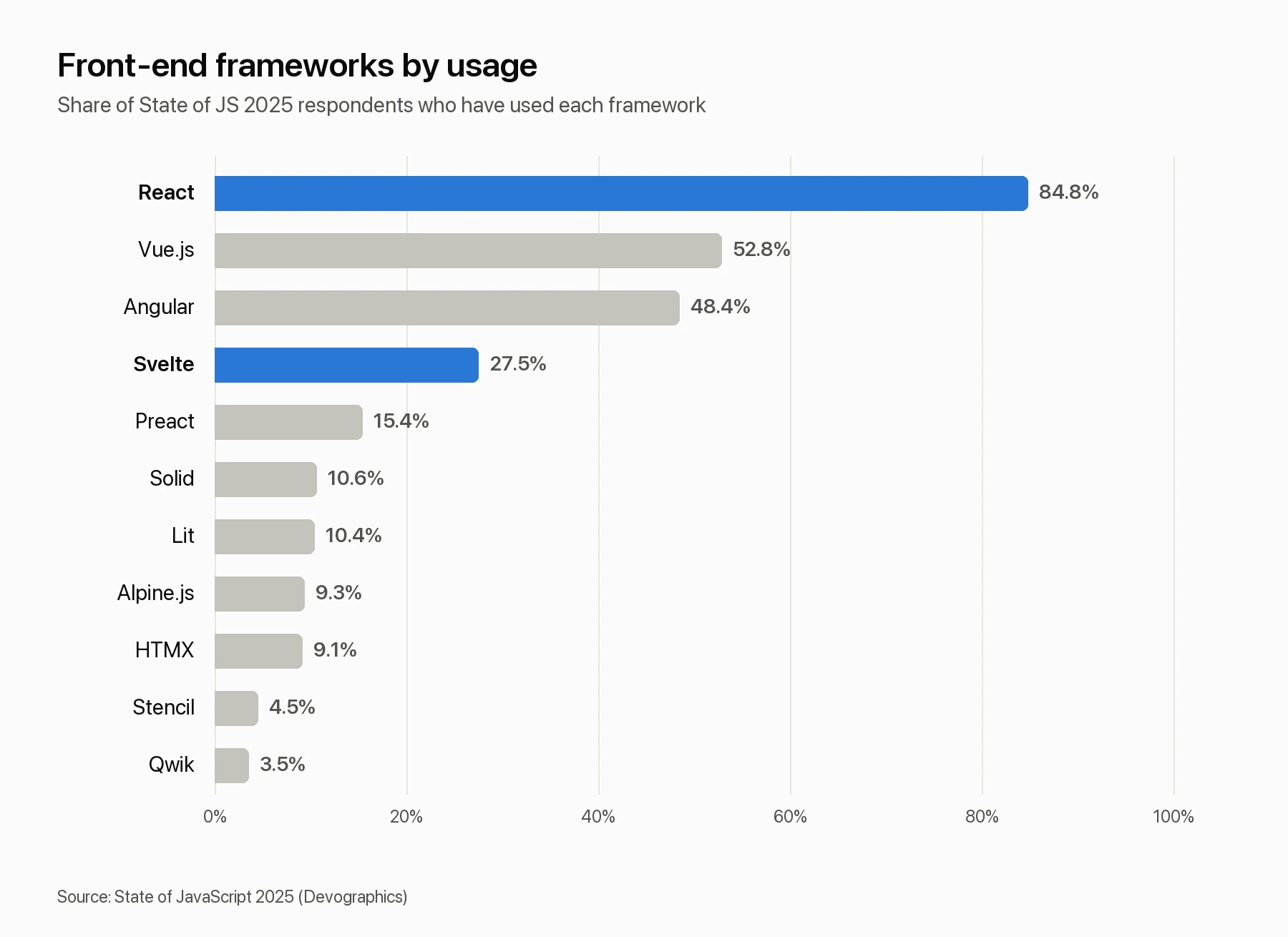
When it comes to popularity, there's no other framework right now which can outperform React. React is the most popular web framework tool as of State of JavaScript 2025 which is quite reasonable when compared to Svelte as React has been around the JavaScript ecosystem since 2013 giving it an edge over a newly developed framework like Svelte.
Scalability and extensibility
Both Svelte and React are scalable and stable production-oriented frameworks. But when it comes to extensibility, React may have a little edge over Svelte, thanks to its huge ecosystem and the community working around it.
There are tons of external libraries and tools made for React as we saw above, which makes React more extensible than Svelte and its relatively small ecosystem.
Speed and performance
When it comes to performance and speed, Svelte can't be out performed by React in any way. As we already saw, Svelte does most of the work in the compile step instead of doing them in the browser which React does. This improves the performance a lot and gives a boost to the server start times.
The next thing which gives Svelte a performance boost is the fact that it doesn't use Virtual DOM. According to Svelte, Virtual DOM might be faster than Real DOM but it's slow. Svelte also has a detailed article about this on their site which you may want to read.
Syntax and learning curve
Both Svelte and React follow component-based development architecture, but the difference comes in the fact that React utilizes JSX, whereas Svelte is a language in itself composed of the three standard languages: HTML, CSS, and JavaScript.
Moreover, Svelte code is much more easily read and has no unnecessary code. The fact that Svelte is truly reactive by default gives it an edge over React in this case.
Talking about the ease of learning, Svelte again has an edge over React — the reason being that most developers are already fluent in HTML, CSS, and JavaScript before they start using a framework. Since React uses JSX, many developers find it overly complex and more difficult to grasp.
Library size
Coming over to the size of the libraries, Svelte is more lightweight, with its minified and GZipped version being only 1.7 KB. React, on the other hand, is almost 44.5 KB minified and GZipped (both React and ReactDOM combined).
As you can see, Svelte is almost 22 times lighter than React, which also means that Svelte apps load faster than React apps by default.
Ecosystem and documentation
We already saw above that React has a much larger ecosystem than Svelte, as it's one of the oldest web frameworks in the JavaScript ecosystem. This means that getting support, code help, and finding resources is way easier while using React than it is with Svelte.
When it comes to documentation, though, Svelte outperforms React. Svelte docs are some of the best standalone resources available for learning Svelte — there's even an in-built interactive tutorial.
React's documentation used to be a common complaint, but the React team launched new docs in 2023, with interactive examples throughout.
Employment opportunities
According to The State of JavaScript 2025, React stands at number one in usage, with about 85% of respondents having used it, while Svelte is ranked fourth at about 28%.
We can clearly see that there is a huge gap between React and Svelte here, which also means that there are more opportunities for work in React than Svelte.
If you're a new developer, we recommend you start with React to increase your chances of getting hired.
Dynamic styling
Both React and Svelte support dynamic styling, but the difference comes in the fact that React supports inline styling through JSX. In Svelte, we put the styles in separate <style></style> blocks in our components file.
Summary
Both React and Svelte are excellent frameworks for building great user interfaces — depending on the use case — and each carries its own pros and cons. You should be able to decide which one suits your needs the best based on the comparison we've laid out here.
If you're a beginner who just wants to improve your skills, you should definitely give Svelte a try. When it comes to performance and satisfaction, Svelte outperforms React in every way.
But if you're an experienced developer and are standing on firm ground already, React would be the best choice for you because it has a vast ecosystem in which finding resources and getting support will be far easier. For a developer whose first priority is getting employed, React is the best choice, with a constant flow of job openings from Junior Developer to Senior Developer and beyond.
Whichever of the two technologies you choose, though, your next step will be to pick a host for your application. For quick deployment through GitHub, look into Sevalla's Application Hosting and Static Site Hosting, which deploy Svelte and React apps straight from your repository.